Children's Creative Activity Centres
What are the KDAP?
The Children’s Creative Activity Centres (KDAP) are a social institution operating under the action “Reconciliation of Family and Professional Life” , with the Hellenic Agency for Local Development and Local Government (EETAA) as the intermediate managing body.
The action aims:
a) to increase employment and job retention among women beneficiaries from low-income families, in jobs on equal terms, so that, through practical support, they can meet their demanding and conflicting roles, such as family care and child protection,
b) to provide real support to beneficiaries, so as to ensure their equal access to work, through quality care and day-care services for infants, toddlers, children and persons with disabilities,
c) to ensure equal access for vulnerable groups (children and persons with disabilities) to quality social services.
The object of the action is to provide beneficiaries with places for the care and day care of infants, toddlers, children and persons with disabilities in the corresponding facilities.
The programme is co-financed by the Operational Programme “Human Resources Development, Education and Lifelong Learning” (EP ANADEDBM) 2014-2020 of the Ministry of Economy & Development and the Regional Operational Programme of the Peloponnese 2014-2020.
Children aged 5-12 can enrol in the KDAP, regardless of which morning school they attend.
Where are the KDAP located?
The KDAP are housed in the buildings of the following Primary Schools:
- 1st (Frangolimna), Kallipatiras & Palaiologou
- 6th (Rachi), 24 Elaiavoulkou
- 8th (Nisaki), Chiou and Ierolochiton
- 9th (Ag. Dimitriou), 3 Lilis Zografou
- 7th Kritis and Akritas
- 14th, (Bournias), Par. Dimitras
- 16th (Polykladiko), Pan. Karkali and Delmouzou
- 21st (Taxiarches), Taxiarchon Square
- Leika
- Paralia Vergas (Verga)
- Asprochoma
- Thouria
- Arfara
Opening hours
The KDAP operate outside the extended school timetable, i.e. from 17.00 to 21.00. To serve parents working an afternoon shift, children can be dropped off from 16.30 and collected until 21.30.
During the summer months and holiday periods, when schools are closed, the KDAP offer creative activities for children in the morning, i.e. from 8.00 to 14.00, to better serve working parents. The KDAP are closed only in August and on public holidays.
What activities do they include (indicatively)?
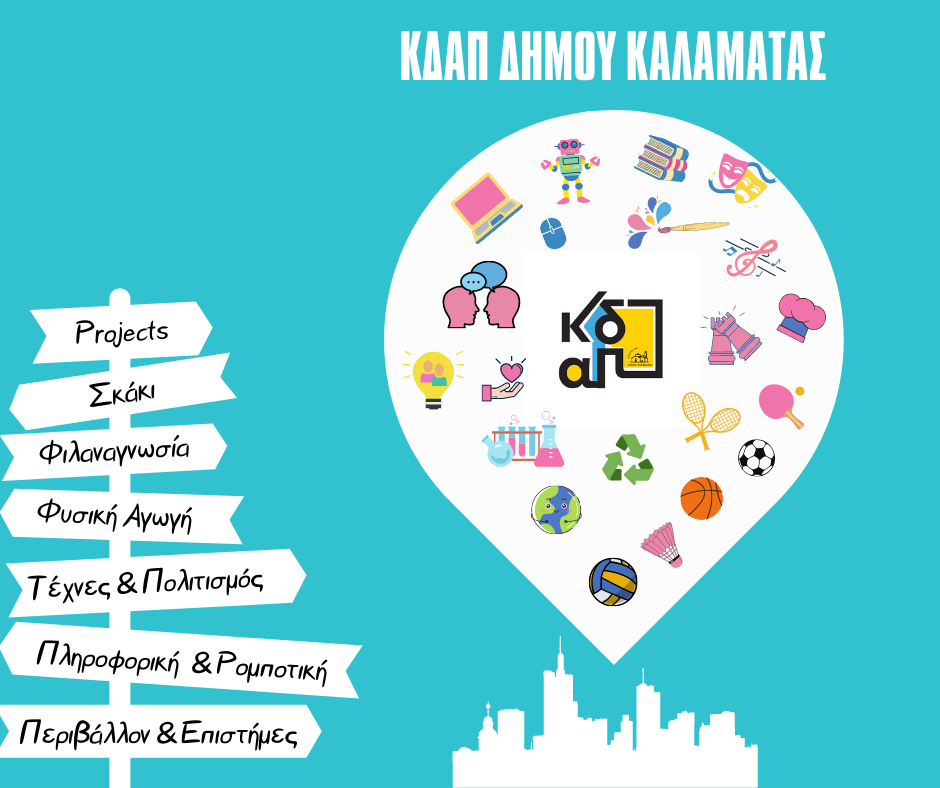
The programme is structured into 7 workshops:
- Reading for Pleasure: Projects, Homework Support, Word Battles, Comic Workshop, Little Agents: Riddles & Crosswords, Mindgames, Picture Stories with Fairy Dust, The Suitcase of Cultures, Little Reporters (Teachers), Play and Learn English (English Teacher)
- Physical Education and Sport: Projects, Volleyball, Basketball, Football, Tennis, Table Tennis, Badminton, Handball, Athletics, Running events, Educational games, Neighbourhood games, Motor skills, Music and movement games, Zumba/PilatesKids (Physical Education Teachers)
- Chess: Learning Chess, The King’s Chessboard, The 64 Squares, Horizontal – Vertical (Chess Instructor)
- Computing & Robotics: Projects, WeDo2.0, LegoEducation, Scratch, Beebot, Computing (Computing Teachers)
- Science & Environment: Projects, Environmental education, Constructions with recyclable materials, Educational board games, Physics & Chemistry experiments, Environmental activities, Little scientists, Gardening, Rocks, Geology, etc. (Environmental studies graduates, Chemist, Physicist)
- Art & Culture: Projects, Drama games, Puppet theatre, Shadow theatre, TV-style games, Drama therapy, Fairy tales, Art workshops, Messyplay, Music, Learning musical instruments, Music and movement education, Karaoke, Traditional dances, Ceramics, Baking and confectionery (Specialist graduates in Music and Theatre Studies, Teachers, Traditional Dance Instructor)
- Skills Workshop: Tackling school bullying and violent practices, Respect for diversity, Volunteering, Environmental awareness, Nutrition & Health, Sex education, Cultural environment, Tackling violent practices (Sociologist)
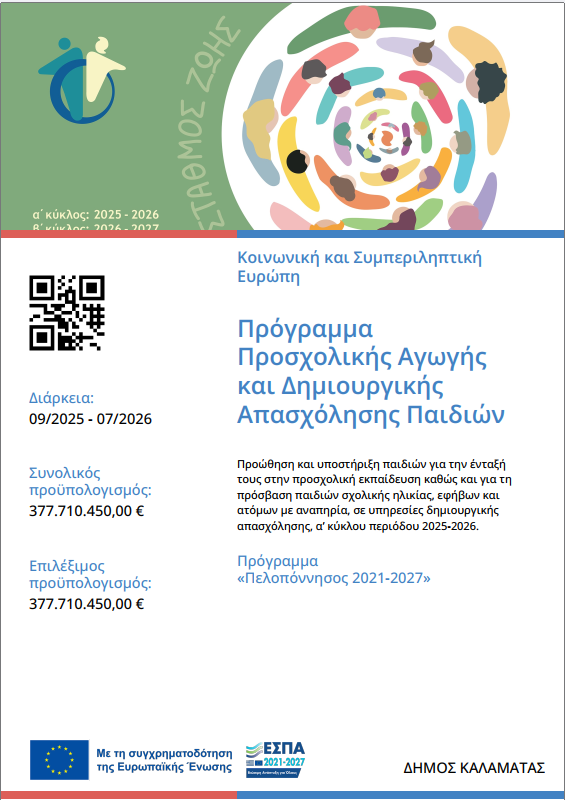
Activities & Events

Co-financed by Greece and the European Union
under the Operational Programme “Human Resources Development, Education and Lifelong Learning” and the 13 Regional Operational Programmes